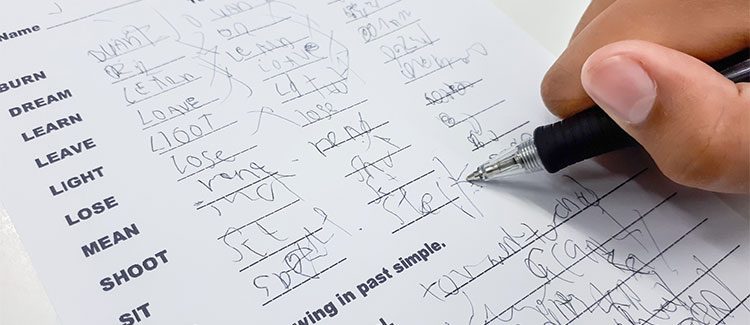

What is dysgraphia?
Dysgraphia is a learning disability that affects writing abilities. It can manifest itself as difficulties with spelling, poor handwriting and trouble putting thoughts on paper. Because writing requires a complex set of motor and information processing skills, saying a student has dysgraphia is not sufficient. A student with disorders in written expression will benefit from specific accommodations in the learning environment, as well as additional practice learning the skills required to be an accomplished writer.
What are the warning signs of dysgraphia?
Just having bad handwriting doesn’t mean a person has dysgraphia. Since dysgraphia is a processing disorder, difficulties can change throughout a lifetime. However since writing is a developmental process — children learn the motor skills needed to write, while learning the thinking skills needed to communicate on paper — difficulties can also overlap.
If a person has trouble in any of the areas below, additional help may be beneficial.
- Tight, awkward pencil grip and body position
- Illegible handwriting
- Avoiding writing or drawing tasks
- Tiring quickly while writing
- Saying words out loud while writing
- Unfinished or omitted words in sentences
- Difficulty organizing thoughts on paper
- Difficulty with syntax structure and grammar
- Large gap between written ideas and understanding demonstrated through speech.
What strategies can help?
There are many ways to help a person with dysgraphia achieve success. Generally strategies fall into three categories:
- Accommodations: providing alternatives to written expression
- Modifications: changing expectations or tasks to minimize or avoid the area of weakness
- Remediation: providing instruction for improving handwriting and writing skills
Each type of strategy should be considered when planning instruction and support. A person with dysgraphia will benefit from help from both specialists and those who are closest to the person. Finding the most beneficial type of support is a process of trying different ideas and openly exchanging thoughts on what works best.
Below are some examples of how to teach individuals with dysgraphia to overcome some of their difficulties with written expression.
Early writers
- Use paper with raised lines for a sensory guide to staying within the lines.
- Try different pens and pencils to find one that’s most comfortable.
- Practice writing letters and numbers in the air with big arm movements to improve motor memory of these important shapes. Also practice letters and numbers with smaller hand or finger motions.
- Encourage proper grip, posture and paper positioning for writing. It’s important to reinforce this early as it’s difficult for students to unlearn bad habits later on.
- Use multi-sensory techniques for learning letters, shapes and numbers. For example, speaking through motor sequences, such as “b” is “big stick down, circle away from my body.”
- Introduce a word processor on a computer early; however do not eliminate handwriting for the child. While typing can make it easier to write by alleviating the frustration of forming letters, handwriting is a vital part of a person’s ability to function in the world.
- Be patient and positive, encourage practice and praise effort — becoming a good writer takes time and practice.
Young students
- Allow use of print or cursive — whichever is more comfortable.
- Use large graph paper for math calculation to keep columns and rows organized.
- Allow extra time for writing assignments.
- Begin writing assignments creatively with drawing, or speaking ideas into a tape recorder
- Alternate focus of writing assignments — put the emphasis on some for neatness and spelling, others for grammar or organization of ideas.
- Explicitly teach different types of writing — expository and personal essays, short stories, poems, etc.
- Do not judge timed assignments on neatness and spelling.
- Have students proofread work after a delay — it’s easier to see mistakes after a break.
- Help students create a checklist for editing work — spelling, neatness, grammar, syntax, clear progression of ideas, etc.
- Encourage use of a spell checker — speaking spell checkers are available for handwritten work
- Reduce amount of copying; instead, focus on writing original answers and ideas
- Have student complete tasks in small steps instead of all at once.
- Find alternative means of assessing knowledge, such as oral reports or visual projects
- Encourage practice through low-stress opportunities for writing such as letters, a diary, making household lists or keeping track of sports teams.
Teenagers and adults
- Provide tape recorders to supplement note taking and to prepare for writing assignments.
- Create a step-by-step plan that breaks writing assignments into small tasks (see below).
- When organizing writing projects, create a list of keywords that will be useful.
- Provide clear, constructive feedback on the quality of work, explaining both the strengths and weaknesses of the project and commenting on the structure as well as the information that is included.
- Use assistive technology such as voice-activated software if the mechanical aspects of writing remain a major hurdle.
Many of these tips can be used by all age groups. It is never too early or too late to reinforce the skills needed to be a good writer.
Though teachers and employers are required by law to make “reasonable accommodations” for individuals with learning disabilities, they may not be aware of how to help. Speak to them about dysgraphia, and explain the challenges you face as a result of your learning disability.
How to approach writing assignments
- Plan your paper: Pull together your ideas, and consider how you want them in your writing.
- Organize your thoughts and ideas
- Create an outline or graphic organizer to be sure you’ve included all your ideas.
- Make a list of key thoughts and words you will want to use in your paper.
- Write a draft: This first draft should focus on getting your ideas on paper — don’t worry about making spelling or grammar errors. Using a computer is helpful because it will be easier to edit later on.
- Edit your work: Check your work for proper spelling, grammar and syntax; use a spell checker if necessary. Edit your paper to elaborate and enhance content — a thesaurus is helpful for finding different ways to make your point.
- Revise your work, producing a final draft. Be sure to read it one last time before submitting it.