HomeAcademics & ActivitiesAcademic Skills

Your first grader and writing

First graders make a habit of writing, a little bit every day.

By GreatSchools Staff

First-graders should have the opportunity to write every day. Young writers divvy up their time in class, writing alone, in small groups, and with the class as a whole. They often learn by working on creative projects and by writing short stories, letters, poems, and songs.

Students should learn the reasons why people write, which include sharing facts, making arguments, and telling stories. Teachers sometimes use hands-on activities to demonstrate the various types of writing. For example, students might try their hand at creating a pattern book with repeated words and phrases, modeling their work on a book they’ve read in class. (A good example of a pattern book is Laura Joffe Numeroff’s If You Give a Mouse a Cookie.) Finally, as a lesson in nonfiction, teachers might ask a student to write about their experiences on a recent field trip.

First-graders should keep a journal, making entries several times a week, since journal writing helps children build writing skills and develop ideas for stories. Journals also encourage inspiration, so kids should be allowed to write about anything that interests them.

Nicola Salvatico, a former national Teacher of the Year, stresses the effectiveness of journals: “Journal writing allows children to take risks where they don’t need to worry about spelling [or] punctuation.” Students can become better writers by making connections between what they write and their daily lives, focusing on the things they find most interesting.

Students should learn about the mechanics of writing, which means spelling and punctuation, and teachers will focus on writing techniques and strategies, like how to use descriptive words and correct punctuation. Kids should learn how to write using the following steps:

  • Prewriting
  • Drafting
  • Revising
  • Editing
  • Publishing
  • Sharing

These steps often help kids organize their thoughts. Beyond reading widely at home, by discussing their ideas with partners during the prewriting stage, students can improve their focus, hone the content and details in their stories, and begin to understand the writing process as a whole.

As Salvatico explains (emphatically), “By taking ownership of their topics, the student’s voice begins to emerge, and writing for the reader becomes the focus. Authors are born!”

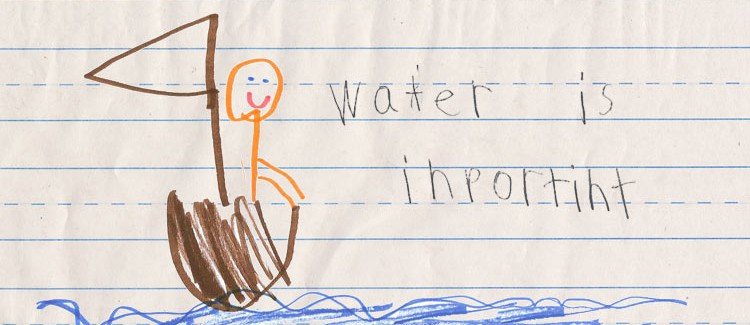
For reference, take a look at these examples of first-graders’ writing from Federal Way Public Schools in Washington State.

Post a comment on this article

Note: Your email address is required if you would like a response from GreatSchools.org.


Comments from GreatSchools.org readers

10/10/2011:
"I just came from my first graders parent teacher conference. He has three grades he has an A- in math, an B in language/writing, and he has a D- in reading and this disappoints me because i saw his reading test and the test has 5 questions he forgot on two out of the tthree test hes taken he forgot to answer to two of the questions which made two of the three test a 60% and a 50%. now the reading test he did good on which means he answered all the questions he got an A- on it. cant his teacher just say make sure u answer all the questions son. instead of saying oh he forgot to answer two questions that really pissed me off because he's a good reader and comphrends very well. now they have 5 weeks left before the grading period ends and 5 test to do will he have enough time to get an A in reading? "
07/19/2010:
"cool"
07/19/2010:
"My first grader does not like to read. She does well with her comprehension, but she seem to simple search for keywords and gets it correctly most of the time. Her writing is ok. She holds the pencil awkwardl and when I attempt to correct her she becomes frustrated. Her teacher says she'll only write about thinks that interest her if she has no interest on a subject she simple says she can't do it. The goal over the summer is to get her to be more interested in reading which may help to develop her writing skills. "
11/9/2009:
"what is a posycoeductive test?"
06/1/2009:
"I think that teachers today are overwhelmed by the amount of children they have to teach and the standards set by the no child left behind act. Parents need to take an active role in their childrens education. I now homeschool all my children.When I sent my oldest to elementary school I always had extra workbooks and writing materials at home as well. If he needed extra practice then I made sure he got it. Dont rely to much on overworked, over stressed teachers to get your child up to par. "
02/25/2009:
" I have a parent who insists her child not 'scribe'. She insists the child bring work home so the mom can type her work. How can I convince her that writing is essential. In the classroom, the child is very capable of printing. Please help."
11/12/2008:
" I would think the teachers would be alittle more connected with the students they teach, however, my grandson is in the first grade and he's being bullied by a 6th grader, yet It's always seems to be his fault. What's wrong with this picture? Also, this school is getting paid by the State of Alabama, to take in troubled kids, ones which get aborted from regular schools, Kids that have no disciplinary teachings. One would think that care and saftey would come first instead of money. "
04/2/2008:
"I'm glad I found this site. We just had Parent-Teacher conferences last night & I jsut now found out that my son (6) isn't at grade-level in writing. He reads and comprehends at 3rd grade level, math skills are at 2nd-3rd grade level, but he struggles at writing & HATES it. I'm very dissapointed at the utter lack of communication from his teacher, but also that his homework doesn't reflect the need for additional practice. Out of 5 homework pages for the week, 3 are math, 1 is reading and only 1 is writing. He has trouble with spacing between words, which I believe is a result of him being left-handed & not able to see where one word ends & the next should begin. When I mentioned this last night, she was amazed & hadn't realized that he was lefty. I asked him to write a sentence, but to lift his hand after each word to see where the next word should start. The result was perfect spacing. I am going to start him with a journal this month to see if his writing improves with a little more practice -- I think it will. I'm just extremely disappointed with the public school and this teacher in particular for not addressing this sooner. They're considering having him repeat 1st grade due to his writing skills, which I am firmly against."
02/27/2008:
"I was told many 1st graders struggle with the silent 'e' at the end of the word. Reading teachers remind them that the 'e' goes on the end to help the vowel( they do learn more about it in 2nd grade). Practicing the word families help too (like hate, kate, rate, skate, etc...) There's a site called starfall.com that helps, too. Hope you enjoy!"
02/20/2008:
"Hi I have a problem with my son he trys to write but when ever there is a word like hate or love or kate he just writes the first three letters. phonatically he is write but i am not able to make him understand the right way to spell. "
02/19/2008:
"I am not sure in my son's class they have those handwriting lessons - he writes not good and I don't see in his notebook they have those letter trainings as you mention : 'First-graders often have handwriting workbooks in which they practice each letter daily.' I am trying to fix him, but I can only do it home, and the most of his handwriting activity is in school. "
02/19/2008:
"I find GreatSchools website to be very informative; I know better what to expect in school for my first and fourth grade children. I also use it to select books to read at the appropriate grade level."
02/15/2008:
"my son is 6 years old in the first grade he is currently still behind most of his class mates and I get very concerened but he stays with my mother because i am currently deployed in the military what can i do to help him catch up ???"
02/15/2008:
"This was very helpful. My son is three and a half and he knows most of his letters and can write his brother's name and his own. We practise writing letters and numbers at home when it's his down/relaxing time. He has his own 'journal' that he uses to 'write' and draw. Am I doing too much, too soon? He enjoys these activities but I don't want to push too much on him. Thank you."
02/14/2008:
"My son is 7 and in the 1st grade. I'm thankful to know we are not the only ones trying to figure all of this out! First grade is not what it was when I was in school. "
02/14/2008:
"thank you, very helpful information"
02/14/2008:
"I am surprised at the level of this writing for first graders, my son is in preK and doing these things and my daughter did this in kindergarten and was already writing 2 page stories while in kindergarten. They do go to a private school. My daughter is in first grade now and can easily write a 4 page paper on a given subject or after reading a chapter book. I find it very surprising that this is first grade work in a public school."
02/14/2008:
"To Step daughter parent: How much do your children read? I have found that reading is also a key factor to spelling. Reading words repeatedly in a book helps them to form the sounds they see and understand them. My 6 1/2 year old 1st grade daughter LOVES to read! She insists on reading at least a book a night before bed and, when friends ask what to get her for Christmas or her birthday... books! She has so many, we can't find room for them. She excels not only in reading, spelling but also in math! I believe that reading helps the child hold interest in what they are doing, as my child is super-hyperactive. No drugs for her though! When she asks for help in sounding out a word, I give her the vowel sound only (unless it's a really difficult word). Then she's able to sound out the rest of the word. When she's doing homework (10 words per week, spelling test on Fridays and another homework, usually math), I tell her to say the word as she's spelling it. Say it first, write it and say it a! gain. When I test her, I make sure to say it slowly and pronounce the letters and syllables heavily so she can hear all the letters. It seems to work as, again, she usually gets 100's. Good luck to you and to those who have trouble. My trouble with my daughter is she's soooooooooo hyper, but they tell me it's a good thing! :)"
02/13/2008:
"My daughter is 6 yrs old first grader and she's reading and comprehending at a fourth grade level. Is this something that happens often and what should I do to keep her moving at this rate ? "
01/18/2008:
"My step-daughter who is now 8 failed first grade last year she's now passing w/ great grades but her little brother who will be 7 in March is in first grade and we're having the same problems.I work w/ him everyday after school. I make him write his words evryday, I quiz him, I've made flash cards, I've baught games and videos to help but he's not getting it. The school recommends that we put him on medicine but we've been down that road his conduct improved but he walked aroung like a zombie and I'm not putting him through that again..If anyone can help me, help him learn please do. It may be too late for the school year but I'm not giving up pn him."
11/12/2007:
"My child started 1st grade in august, the teacher started giving them spelling test and at the parent teacher conference (3 wks after school start) she told me that she wants to have a psycoeductive test because he was not writing correctly. Is this enough time to evaluate a child that is supposed to learn those skills now? "
10/22/2007:
"I teach first grade and it's horrible to see all the comments left on what other teachers are doing to these poor 5, 6, and 7 year olds! I would never send homework like that home...word study should be fun and an interaction between parent and child. Parents in my class study with their child how they see fit at home. I do weekly book reports to gain comprehension...my students grades have shot through the roof:) If you are sturggling with your teacher assigning too much homework, ask the principal what the amount is nightly for first graders."
10/9/2007:
"My child is the third week of first grade and the teacher has informed us that she wil be grading him on a daily bases every time he writes. All letters should be correctly formed each time they print.He has at least seven types of homework every night. It is a shame to see him so stressed out."
09/20/2007:
"FYI ---There is ABSOLUTELY NO ACADEMIC VALUE to words searches. There have been numerous studies done. I'm not saying the way the rainbow words were done were correct eitheir, however there is studies on how color and letters help students remember words. Maybe that was teh teacher's thinking. "
07/27/2007:
"My daughter is about to start 1st grade and I am very worried. One of the childern I baby-sit has just finished 1st and he never learned the meaning of the words or their parts of speech. When will the childern start to learn about those things."
06/18/2007:
"My granddaughter recently spent the las 2 yeas k4 and k5 in a christian school which used the Abeka cirriculum. now she will be attending a public school for first grand and i am worried about her being on a higer learning leavel then the children that may not be as advanced. Do you think the teacher would be able to spot this situation. I had this problem with my children when they went to public school from private (different state). Do you have any suggestions for me as we make this move."
01/10/2007:
"Comment on repetitive word writing: Our 1st greader started out having to write 20 words three times each in a different color...he hated it and seemed counter productive to the learning process. His teacher then gave the kids a couple of other choices such as word searches and crossword puzzles as well as 'ABC' order...if the kids still wanted to do the 'rainbow words' they could so. My child has not done 'rainbow words' since that day and he regularly brings home 100% correct on his tests including a weekly compliment of bonus words. My opinion is that having to really think about the word through word searches, etc. is much more effective and fun to boot!"
01/10/2007:
"Excellent article!! Lets me know that my daughter is right on track!"
ADVERTISEMENT

Connect With Us

Sign up for daily tips and ideas that will enrich your child's education.

ADVERTISEMENT