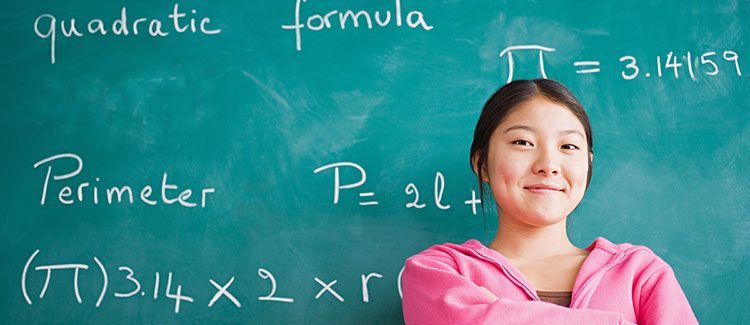

Becoming an algebra expert opens the doors to some of today’s most trendy (and well-paid) careers. From computer science to medicine, algebra serves as a foundational skill. Understanding algebra also puts students on track for college success, no matter what major they choose. Here’s how you can make sure your children develop the algebra skills they need to succeed.
Why algebra matters
Algebra is one of the few major domains of mathematics that students study from preschool all the way through twelfth grade, says Matt Larson, president of National Council for Teachers of Mathematics (NCTM). “Algebra is critically important because it is often viewed as a gatekeeper to higher-level mathematics and it’s a required course for virtually every postsecondary school program,” he says.
Because so many students fail to develop a solid math foundation, an alarming number graduate from high school unprepared for college or work. Many end up taking remedial math in college, which makes getting a degree a longer, more expensive process than it is for their more-prepared classmates. And entering college without an understanding of algebra means students are less likely to complete a college-level math course, which can take them off track for graduation. For middle schoolers and their parents, the message is clear: it’s easier to learn the math now than it is to try to learn — or relearn — it later.
The first year of algebra is a prerequisite for all higher-level math: geometry, algebra II, trigonometry, and calculus. Researchers have found in multiple studies that students who take more high-quality math in high school are more likely to declare science, technology, engineering, and mathematics (STEM) majors in college. Students who take Algebra II in high school are also more likely to enroll in college or community college.
Algebra can lead to many new opportunities for success in the 21st century. What’s more, when students make the transition from concrete arithmetic to the symbolic language of algebra, they develop abstract reasoning skills necessary to excel in math and science.
When should kids take Algebra I?
Students typically take algebra in eighth or ninth grade. An important benefit of studying algebra in eighth grade is that if your child takes the PSAT as a high school sophomore, she will have taken geometry as a ninth grader. By the time she’s ready to take the SAT or ACT as a junior, she will have completed Algebra II, which is covered in both of these college admissions tests.
There’s a growing movement to require algebra in seventh grade, but math educators say many seventh graders aren’t prepared for it.
“Some kids get turned off of math because they start math too early,” says Francis “Skip” Fennell, professor emeritus at McDaniel College and former president of NCTM. If you’re wondering whether your child is ready to advance, he recommends talking to her current teacher. The goal is for your child to master algebra and stay engaged in math, not to push through the curriculum quickly just to get it done.
Math mindsets matter
Algebra I isn’t the first step toward math success — students begin exploring algebraic reasoning in kindergarten (and, ideally, even in preschool). Researchers say that a powerful way to help your child build a strong foundation in math is by encouraging them to develop a positive mindset about math.
A strong mathematical mindset refers to how your child thinks about her ability to succeed in math class. It’s similar to having a “can do” attitude. Research has proven that having a positive attitude towards math contributes to higher math test scores and a better understanding of essential math skills.
“One of the most important things parents can do is simply be positive about mathematics,” Larson says, “and point out where they themselves use mathematics and see mathematics in the world.” For more on how to support your child’s development of a positive mathematical mindset, you can visit www.youcubed.org, a free resource from Stanford University that hosts information for both parents and students.
Is your child on track?
Whether your state is using the Common Core State Standards or has mathematics standards of its own, Larson says math standards across the country are rigorous and consistent.
To see if your child is learning what she should know in her grade level, you can read about the math expectations for your child in kindergarten, first grade, second grade, third grade, fourth grade, fifth grade, sixth grade, seventh grade, and eighth grade under Common Core or check the NCTM’s guide for algebra standards. The guide outlines simple math knowledge expectations from preschool through 12th grade.
The answer is in the homework
Homework can offer telling clues about the quality of mathematics instruction. “A worksheet with 50 problems out of context where students are moving symbols around for no apparent reason would be cause for parents to engage their child’s teacher in a conversation,” Larson says. Instead, homework should be rich with context and should demand analytical thinking.
“Parents should appreciate that learning mathematics is sometimes challenging,” Larson says, “and it’s not necessarily a good sign if everything is very easy. Students should be appropriately challenged to use problem-solving skills.”
To do some homework of your own, Fennell suggests talking to your child and her math teacher about how homework is used. You can ask:
- Are homework assignments corrected and returned in a timely way?
- Is homework reviewed in class so students can learn from their mistakes?
- Does the teacher change the pace or direction of his or her instruction, based on student feedback?
You don’t need to be a mathematician to ask good questions about your child’s curriculum, Fennell adds. “Ask the teacher, ‘Is it a repeat of math that should have already been mastered? When my child finishes this year, will he be ready for high school math?'”
How much should students rely on calculators?
The issue of calculators has been debated by math teachers, university professors, and parents, but there is general agreement that calculators shouldn’t be a substitute for learning basic arithmetic and standard algorithms.
Larson believes the use of calculators is not a yes or no question. While he says technology can help build a deeper understanding of key algebra concepts, students should still learn how to practice standard procedures on their own.
You don’t want to see students go straight to calculators, Fennell says. “The calculator is an instructional tool,” says Fennell. “It should support but not supplant anything. You don’t use it for 6 x 7.”
Updated September 2017